A power bank is a battery in a box with a USB socket, carried so that a phone never runs flat away from a plug. Choosing one comes down to three questions: how much it holds, how fast it charges, and how it fits the way you carry things. This guide explains the mAh number and why it never matches the charges you get, the sizes from pocket to camping, the different kinds, how fast they work, the rules for taking one on a plane, and how to look after one safely.
What mAh means, and how many charges you really get
mAh stands for milliamp-hours. It is a measure of how much charge a battery holds, and the bigger the number, the more it holds. A 10,000mAh power bank holds twice as much as a 5,000mAh one. So far, so simple. The confusion comes when you compare that number with your phone's battery.
Why a 10,000mAh bank does not give 10,000mAh
The mAh figure on a power bank is measured at its battery cells, which run at around 3.7 volts. A phone charges over USB at 5 volts or more. Raising the voltage costs some energy, lost as heat, and the phone's own charging circuit loses a little more. Anker, one of the large power bank makers, explains this in its support pages and uses an overall figure of about two-thirds in its worked example: roughly two-thirds of the mAh on the box ends up in the phone's battery.
Working it out for your phone
Take the power bank's mAh, multiply by two-thirds, and divide by your phone's battery size. Phone makers do not all publish battery size the same way. Samsung gives it on its specification pages: the Galaxy S25's typical capacity is 4,000mAh, for example. For a phone of that size:
| Power bank | Roughly reaches the phone | Charges of a 4,000mAh phone |
|---|---|---|
| 5,000mAh | about 3,350mAh | a little under one |
| 10,000mAh | about 6,700mAh | about one and a half |
| 20,000mAh | about 13,400mAh | about three |
| 30,000mAh | about 20,100mAh | about five |
These are rough figures. Fast charging, a warm day, an old power bank and using the phone while it charges all reduce them. A phone with a smaller battery gets more charges, and a big phone or a tablet gets fewer.
Why real life gives less again
Most people do not run a phone to empty and fill it to full from a power bank. They top up from 30 per cent to 80, or keep the phone on the power bank while using it for maps or music. Charging a phone that is busy means some of the power runs the phone rather than filling the battery, so each top-up costs more. A power bank also slowly loses charge sitting in a drawer, so one filled a month ago will not be full today. And like a phone's battery, a power bank's battery holds less as it ages, after hundreds of charges. A sensible plan is to buy one size larger than the sum says you need.
Watt-hours: the number airlines use
A second figure, watt-hours (Wh), measures the energy in the battery rather than the charge. It matters for flying, below. Many power banks print it. If yours does not, work it out: multiply the mAh by the cell voltage, usually 3.7, and divide by 1,000. A 10,000mAh power bank at 3.7 volts is 37Wh.
Choosing a size: 5,000 to 30,000mAh and over
Bigger holds more, but it also weighs more, takes longer to recharge and costs more. The right size is the smallest that gets you through your usual day or trip.
5,000mAh: a top-up
5,000mAh power banks are small enough for a pocket or a small bag and give most phones a good top-up, from low to most of the way full. They suit an evening out, a long day at work or a phone whose battery has started to fade.
10,000mAh: the everyday size
10,000mAh power banks are the usual choice for everyday carrying and a weekend away: one full charge and more for most phones, in something still small enough for a coat pocket or handbag.
20,000mAh: trips and sharing
20,000mAh power banks suit travelling, festivals, long journeys and charging two phones, or a phone and a tablet. They are heavier, more for a rucksack than a pocket.
30,000mAh and over: camping and power cuts
Power banks of 30,000mAh and over are for several days away from power, camping, or keeping phones going in a power cut. Some can charge a laptop. They are heavy, they take a long time to recharge, and the biggest are over the airline limits described below. See also high-capacity power banks.
Size against weight
The honest test of a power bank is whether you take it with you. A large power bank left at home because it is heavy charges nothing. Think about where it will live: a coat pocket, a handbag, a work bag or a rucksack. Then pick the biggest size that fits there without being a nuisance. For many people, that means two: a small one for every day, and a large one for trips and power cuts.
Magnetic, slim, mini and built-in cable power banks
Size is one choice. The shape and the way it connects to the phone is the other, and it decides whether you actually carry it.
Magnetic power banks
Magnetic power banks click onto the back of the phone and charge it wirelessly, with no cable. They work with phones that have magnetic wireless charging built in, or with a magnetic case or ring on other phones. They are the easiest to use on the move, because the phone stays usable while it charges. Wireless charging is slower and less efficient than a cable, and warmer, so a magnetic power bank gives fewer charges than its mAh suggests, and many also have a USB-C socket for a faster wired charge. The guide to wireless and magnetic charging explains the standards.
Slim power banks
Slim power banks are thin and flat, made to slip into a jacket pocket or the inside pocket of a bag.
Mini power banks
Mini power banks are small capsules that plug straight into the phone's charging port, with a USB-C or Lightning plug on the end, so there is no cable at all. They make the phone a little longer while they charge. Check the plug matches your phone; the guide to charging cables lists which phones use which.
Power banks with built-in cables
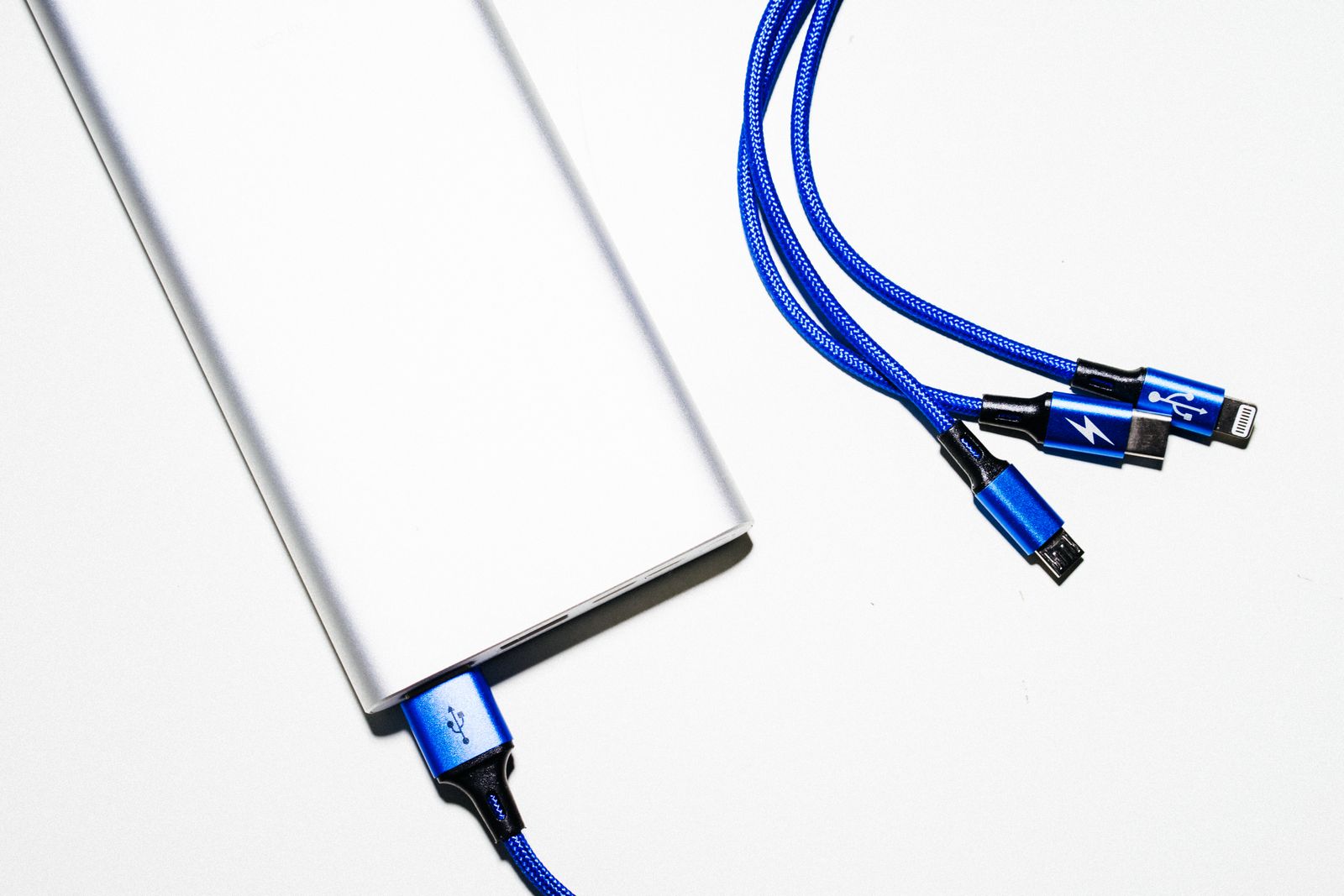
Power banks with built-in cables carry their own cable, often USB-C and sometimes Lightning as well, tucked into the case. The point is simple: the cable cannot be left at home. If yours has none, a short cable is the right length for a power bank in a pocket.
Solar and hand-crank chargers
Both of these promise power without a socket, and both are best thought of as a back-up rather than an everyday charger.
Solar power banks
Solar power banks are ordinary power banks with a small solar panel on the face. The panel is small, and a phone-sized panel in British daylight charges the battery inside very slowly. Expect it to top the power bank up over a long sunny day, not to fill it. The sensible way to use one is to fill it from the mains before a trip, use it like any other power bank, and let the sun add a little each day while camping or walking. Leave it in the sun facing upward, but not baking on a car dashboard, as heat is bad for the battery inside.
Hand-crank chargers
Hand-crank chargers make power from turning a handle. A good amount of turning gives a modest amount of charge, enough for a call or a message in an emergency rather than a full phone. They are for the emergency kit, the boat or the car boot, where a charger that never runs flat is the point. Some also carry a torch or a radio.
Charging speed in and out
A power bank has two speeds: how fast it charges the phone, and how fast it refills itself. Both are printed on it, as watts or as volts and amps.
Charging the phone
For a phone to fast-charge from a power bank, the power bank needs the same thing a wall charger needs: USB Power Delivery on a USB-C socket, and PPS for Galaxy and recent Pixel phones. A power bank with a 20W PD output fast-charges most phones; a bigger output helps tablets and laptops. A power bank with only USB-A sockets, or with no PD, will charge a phone, but slowly. The fast charging guide explains PD and PPS.
Refilling the power bank
This is the speed people forget, and on a big power bank it matters most. The input speed decides how long it takes to fill. A rough sum: divide the power bank's watt-hours by the input watts, and add some for losses. A 20,000mAh power bank holds about 74Wh, so on a 10-watt input it needs well over seven hours; on a 30-watt USB PD input it needs closer to three. For a big power bank, a fast USB-C input and a matching wall charger save a long wait.
Pass-through charging
Some power banks can charge a phone while they are being charged themselves, called pass-through charging. It is handy on a bedside table in a hotel with one socket. It also adds heat, so do it on a hard surface, in the open, and not unattended.
Charging two things at once
Many power banks have two or three sockets, so a phone and a pair of earbuds, or two phones, can charge together. As with a wall charger, the output is shared. A power bank printed with a 20-watt USB-C output may give less to each socket when two are in use, and some drop every socket back to plain 5-volt charging when more than one is busy. The split is printed on the power bank or its box, socket by socket. If you often charge two phones at once, look for a power bank whose total output covers both, and remember that sharing empties it twice as fast: a 10,000mAh power bank split between two phones gives each of them less than one full charge.
Taking a power bank on a plane
Lithium batteries can overheat and catch fire, and a fire in the hold of an aircraft is very hard to deal with. So the rules for power banks are strict, and the UK Civil Aviation Authority (CAA) sets them out on its Pack Right pages.
The CAA's rules
- In the cabin, never the hold. Power banks must go in your hand luggage, with you, and never in checked luggage. If your cabin bag is taken to go in the hold at the gate, take the power bank out first.
- Two per person. The CAA allows two power banks per passenger.
- Do not recharge them on board. The CAA says power banks should never be recharged on the aircraft.
- Protect them from short circuit. Keep each one in its original packaging, a pouch or a separate bag, so its sockets and any exposed contacts cannot touch keys or coins.
The size limits
The limits are in watt-hours, which is why that number matters.
| Watt-hours | What the CAA says | About this many mAh at 3.7 volts |
|---|---|---|
| Under 100Wh | Allowed in the cabin | up to about 27,000mAh |
| 100Wh to 160Wh | Needs the airline's approval | about 27,000 to 43,000mAh |
| Over 160Wh | Not allowed in passenger baggage | over about 43,000mAh |
So a 10,000mAh or 20,000mAh power bank, at 37Wh and 74Wh, is well within the first limit. A 30,000mAh power bank with 3.7-volt cells works out at 111Wh, over 100Wh, so it needs the airline's approval before you fly. Read the watt-hours printed on your own power bank, because cell voltages vary and the printed figure is the one that counts at the airport.
Check with the airline
The CAA tells passengers to check with their airline before flying, because some airlines have extra rules of their own, which can be stricter than the CAA's. The airline's rules apply on top of the CAA's, so the airline's own website is the last word for your flight. And if a power bank is damaged or looks swollen, do not take it; Electrical Safety First advises telling airline staff straight away if you notice one is damaged or deformed.
Before you fly: a short checklist
- Find the watt-hours printed on each power bank, and check they are under 100Wh, or that you have the airline's approval for one between 100Wh and 160Wh.
- Take no more than two.
- Pack them in your hand luggage, each in its own pouch or packaging.
- Check your airline's own rules for power banks, on its website, close to the day you fly.
- Charge them at home before you leave, as you cannot recharge them on the plane.
- Leave behind any that are swollen, cracked or damaged.
Looking after a power bank safely
A power bank holds a lot of energy in a small space, and a damaged one can overheat or catch fire. Electrical Safety First's advice for power banks is clear.
Signs to stop using it
Stop using a power bank, and unplug it if it is charging, if you see any of these:
- swelling, bulging, or a case that no longer closes flat;
- cracks, a split case or damage from a drop;
- an odd smell, smoke or sparking;
- getting too hot to hold.
Never charge a swollen, damaged or hot power bank, and do not take it apart or try to repair it. Contact the seller or maker. Put a swollen power bank somewhere it cannot be crushed, away from anything that burns, until you can take it for recycling.
Charging it
- Charge it uncovered, on a hard surface, somewhere with air around it, not on a bed or sofa or inside a bag.
- Electrical Safety First advises not charging power banks overnight or while you are out of the house.
- Unplug it once it is full.
- Use a proper charger with a UK three-pin plug. The guide to choosing a safe phone charger explains what to look for.
Storing it
Keep it out of hot cars, direct sun and places that freeze. If you are putting one away for a long time, Apple's advice for storing its own devices applies to the same kind of battery: store it about half charged, somewhere cool, and top it up to half every six months. A lithium battery left completely flat for months can stop holding charge.
Getting rid of one
Never put a power bank in the household bin or the recycling. Electrical Safety First warns that crushed lithium batteries cause fires in bin lorries and at recycling centres. Take it to a battery recycling point, such as the battery bins in many shops or your council's recycling centre.
Questions people ask
How many times will a 10,000mAh power bank charge my phone?
For a phone with a 4,000mAh battery, about one and a half full charges. Roughly two-thirds of the number on the power bank reaches the phone.
Can I take a 20,000mAh power bank on a plane?
At 3.7 volts it is about 74Wh, under the CAA's 100Wh limit, so yes, in your hand luggage only. Check your airline's own rules too.
Can I take a 30,000mAh power bank on a plane?
Only with the airline's approval, as at 3.7 volts it is about 111Wh. Check the watt-hours printed on it and ask the airline before you fly.
Is it bad to leave a power bank plugged in?
Unplug it once it is full. Electrical Safety First advises not charging power banks overnight or while you are out.
Why does my magnetic power bank give fewer charges than its size suggests?
Wireless charging loses more energy as heat than a cable does. Use its USB-C socket and a cable when you want to make the most of it.
Can I pack a power bank in my suitcase?
No. The CAA says power banks must never go in checked luggage. They travel in the cabin, with you, in your hand luggage.
Where to go next
Every kind is in power banks, and by size from 5,000mAh to 30,000mAh and over. For trips, for travellers gathers power banks, adapters and travel chargers. Delivery is included in every price and tracked to your door.
- Fast charging explained: watts, USB Power Delivery and PPS
- Choosing a safe phone charger in the UK: the law, warning signs and recalls
- Wireless and magnetic charging explained: Qi, Qi2 and magnetic charging
- Which charging cable does my phone need?: the right plug for your phone