A phone charm is a small thing that hangs from a phone: a string of beads, a pearl, a short chain, a heart or a tiny cartoon face. A phone strap is the same idea made useful, a loop that goes round the wrist, a finger or the body so the phone is harder to drop or leave behind. This guide goes through the kinds of charm and strap, the themes people choose, how a charm actually fixes to a phone that has no hole for it, how to match one to a case, what to think about when buying one as a present, and the safety point that matters most: small parts and young children.
Why phone charms are back
Charms on phones are not new. They began in Japan, where they are called keitai straps, keitai being the everyday Japanese word for a mobile phone. Phones there were made with a small hole or loop in the body for a strap to go through, and people hung all sorts from them, from souvenirs of places they had been to favourite cartoon characters. The idea travelled, and plenty of small handsets elsewhere had a strap loop too.
Then came the smartphone. A modern phone is a smooth slab of glass and metal, and almost none of them has a strap hole.
From 2021, fashion magazines and websites began reporting that phone charms had come back, as part of the return of early-2000s style that is often called Y2K: bright colours, beads, butterflies and playful shapes. One explanation they gave was lockdown. With the phone the main link to friends and the outside world for months, people wanted it to look like theirs, and beading at home became a popular thing to do.
Whatever started it, the reasons people give for a charm are simple enough:
- a phone case looks much like everyone else's, and a charm is a small, cheap way to make the phone yours;
- a charm makes a phone easier to find in a bag, and easier to tell apart from a friend's phone on a table;
- a strap makes the phone harder to drop, and harder to leave behind;
- a charm can be changed with your mood, your outfit or the season, without buying a new case.
The kinds of charm: beads, pearls, chains, crystals and cute
Most charms are one of five kinds, and many mix two or three. All of them end in a small loop of cord, a ring or a clasp that fixes them to the phone, which is covered further down.
Beaded charms
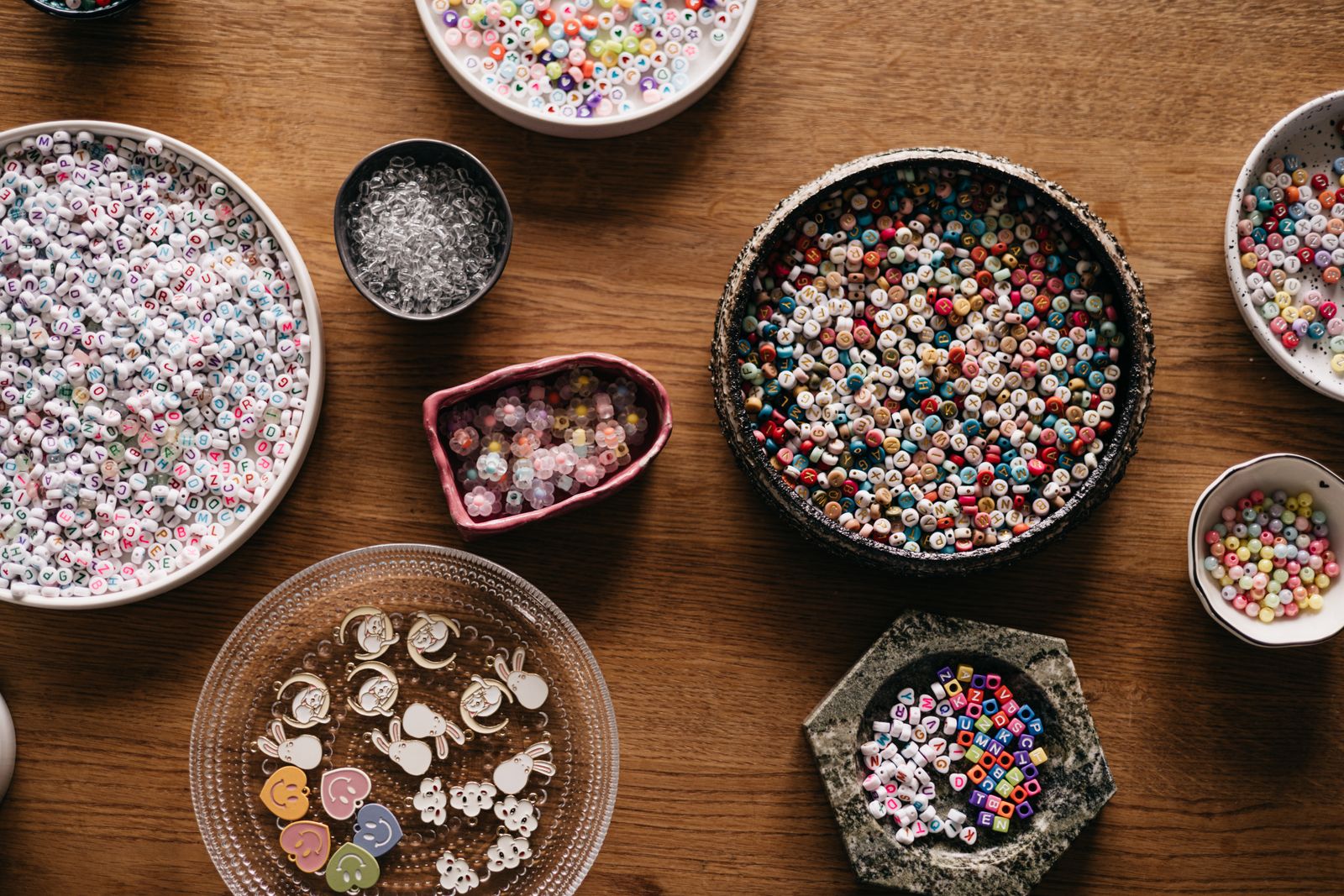
A string of beads on a cord, finished with a loop at the top. Beads come in glass, acrylic, wood, clay and metal, in every colour, and in sizes from tiny seed beads, a couple of millimetres across, to big round or shaped beads. A beaded charm can be a short dangle of a few beads, or long enough to loop round the wrist and double as a strap. Beads are light, they make a soft clicking sound, and the colours can be matched to almost anything. See beaded phone charms.
Pearl charms
Pearls give a softer, more grown-up look than bright beads, and they go well with white, cream, pale pink and clear cases. Some use real freshwater pearls; many use pearl-look beads, glass or plastic with a pearly coating, and a description that says faux pearl or imitation pearl means these. The coating on a pearl-look bead can wear where it rubs, so wipe pearls with a soft dry cloth rather than scrubbing them. See pearl phone charms.
Chain charms
A short length of metal chain, often with a pendant or a few beads on it. Chains look smart and suit plain black, silver or gold cases. Two things to know. First, most chains at everyday prices are plated, a thin layer of colour over another metal, and plating can wear through where the chain rubs. Second, the NHS lists nickel in jewellery as one of the common causes of contact dermatitis, an itchy skin reaction, so if a cheap necklace or watch strap has ever made your skin red, choose a chain charm that will not rest against your skin, or a description that says nickel-free or stainless steel. See chain phone charms.
Crystal and rhinestone charms
Charms set with cut glass or acrylic stones that catch the light. They suit a glitter case, an evening out, or anyone who simply likes a phone that sparkles. Stones are usually glued into their setting, so a crystal charm that gets knocked about can lose one. Check it now and then and keep it out of the way of keys in a bag. See crystal and rhinestone charms.
Cute charms
The biggest family of all: small figures, animals, faces, sweets, clouds, little plush toys and pompoms, charms that glow in the dark after being in the light, charms with a tiny bell, and charms with a tassel. They are often bright and soft, and they are the ones most people mean when they talk about the Y2K look. Plush and pompom charms are soft against the phone but pick up dirt, so they suit someone happy to give them a gentle wash. See cute phone charms.
Themes: hearts, stars, flowers, butterflies, fruit and evil eye
As well as the kind of charm, many people choose by theme. A theme is a good way to pick a present, and an easy way to make several charms look as if they belong together.
Hearts
The most common theme of all, in every material from pink acrylic to silver metal and red glass. Hearts suit friendship and couples: matching pairs are popular as a present for two people, sometimes with each charm half of one heart. See heart phone charms.
Stars and moons
Stars, crescent moons and planets, often in gold or silver tones or in pale blues and purples. They suit a dark case and anyone who likes the night sky. Some star charms are made to glow in the dark, which also helps find a phone in a bag at night.
Flowers and daisies
Daisies, tulips, cherry blossom and small clay flowers, often strung with pearls or pastel beads. Flowers go with the soft, pale look that is sometimes called aesthetic, and with clear cases that have pressed flowers in them.
Butterflies
Butterflies are one of the shapes most linked with the early-2000s look, in bright acrylic, glitter or crystal, and they mix well with beads in the same colours. See butterfly phone charms.
Fruit and food
Strawberries, cherries, lemons, peaches, sweets and cakes, usually in clay, resin or acrylic. They are bright and fun, they suit summer, and they make an easy present for someone with a favourite fruit or a sweet tooth.
Evil eye
The blue eye bead comes from an old belief, found from ancient Greece and Rome to Jewish and Islamic traditions and across the Mediterranean and the Middle East, that an envious look can bring harm or bad luck. The eye-shaped bead, known in Turkey as a nazar, is worn to turn that look away. Today many people wear it for its meaning, as a wish for good luck, and many simply for the deep blue colour. See evil eye charms.
Straps: wrist, finger, crossbody and neck
A strap is a charm with a job. It ties the phone to you so it is harder to drop, harder to leave behind and easier to reach. Straps come in four lengths, each for a different way of carrying the phone. See phone straps for all four.
Wrist straps
A short loop that goes over the hand and sits round the wrist. If you let go of the phone, it hangs from your wrist instead of falling to the ground. Wrist straps are good for taking photos over a railing, on a boat, at a concert, or anywhere a dropped phone would be lost. Many beaded charms are long enough to work as a wrist strap.
Finger straps and loops
A short strap or band across the back of the phone that a finger or two slides under. It holds the phone steady in one hand while you scroll, type or take a photo, which helps on a large phone.
Crossbody straps
A long strap that goes over one shoulder and across the body, so the phone hangs at the opposite hip like a small bag. Your hands are free, and the phone is there when you need a ticket, a map or a payment. Crossbody straps come adjustable, braided, beaded and in chain, and the guide to crossbody phone lanyards goes through choosing and fitting one.
Neck straps
A strap that goes round the neck so the phone hangs at chest height. They are handy at work, at events and for anyone who wants the phone in sight at all times. A neck strap is the one to keep away from small children, for the reason given in the safety section below.
How a charm attaches to a phone
This is the part that puzzles most people, because most phones have no hole for a charm. There are four ways to fix one on, and the first two work with almost any phone.
A lanyard patch
A patch, also called a tether or tab, is a thin flat piece of plastic, rubber or fabric with a loop or a hole at one end. You take the case off, lay the patch on the back of the phone with the loop at the bottom, and put the case back on. The loop then pokes out through the opening at the bottom of the case where the charging cable goes in, and the charm or strap ties onto that. Because the case holds the patch against the phone, it is surprisingly strong. It needs a case with an opening round the charging port, which most cases have, and it may make a very tight case a little tighter. After fitting it, check that the charging cable still plugs in fully. See lanyard patches and tethers.
A case with a lanyard hole
Some cases have a small hole, slot or loop moulded into a corner or the bottom edge, made for a strap. This is the neatest way, with nothing between the phone and the case. If you are buying a new case anyway and know you want a charm, it is worth choosing one of these. See cases with lanyard holes, and the guide to choosing a phone case for the rest of that choice.
A dust plug charm
A charm on a small plug that pushes into the charging port. It needs nothing else, and it keeps fluff out of the port. The plug has to match the port, USB-C or Lightning, and it has to come out each time you charge with a cable or plug in wired earphones. It should push in snugly but without force. See dust plug charms.
Rings and clasps
Many charms end in a cord loop, and a cord loop goes on with a simple hitch: push the loop through the hole or the patch, pass the whole charm through the loop, and pull it snug. Others end in a split ring or a clasp. A clasp, such as a small lobster clasp, lets you swap charms in seconds, or hang several from one point. See charm rings and connectors for the rings, clasps and loops that join one thing to another.
One thing to watch with wireless charging. A charm that hangs from the bottom of the phone does not get in the way, but anything that sits between the phone and the charger can. A lanyard patch is thin and sits at the bottom edge, so most people never notice it. If wireless charging becomes slow or stops after you fit one, take the patch out and try again.
Matching charms to a case
A charm is seen against the case, so the two are worth choosing together.
- A clear case shows the phone's own colour, so pick a charm that suits the phone: pearls and silver on a white or silver phone, gold tones on a gold or cream one, any bright colour on a black phone.
- A plain coloured case is the easiest of all. Choose one colour from the case for the charm, or a colour that sits beside it, such as lilac beads on a pink case.
- A patterned or printed case is already busy. Pick one colour out of the pattern and use a simple charm in that colour, so the two do not compete.
- A cute case, with a face or a character, often looks best with a charm from the same world: the same animal, the same colours, or a theme such as fruit or stars.
Think about size as well as colour. A short charm that hangs just below the phone stays out of the way in a pocket and on a desk. A long charm or several charms together make more of a statement, but they swing, tangle and tap against the screen and the camera. If the camera lenses stand out from the back of the phone, keep metal and hard stones short, or hang them from a strap rather than straight from the phone.
Charms as presents
A charm makes a good small present, and it has one great advantage over a case: it does not depend on the model of phone. You do not need to know whether someone has the latest phone or one from four years ago, only what they like.
A few ideas that work well:
- initials or a name in letter beads, which the guide to making a phone charm shows how to make;
- a matching pair for two friends, a couple, or a parent and an older child;
- a theme you know they love, such as a favourite animal, fruit or colour;
- a wrist or crossbody strap for someone who is always dropping their phone or leaving it behind;
- a set of several charms with a clasp, so they can swap them about.
The one thing that does depend on the phone is how the charm fixes on. If you do not know whether their case has a strap hole, add a lanyard patch, which works with most cases. Boxed sets that put charms and straps together are made for giving. See charm gift sets. Delivery is included in every price and tracked to your door.
If the present is for a child, read the next section first.
Small parts and young children
Phone charms are made for older children and adults. They are not toys, and most of them are full of the small parts that are dangerous to babies and toddlers.
Small parts
The NHS warns that young children put small objects in their mouths and can choke on them, and advises keeping things such as buttons, coins and small toy parts out of their reach. Beads, pearls, bells, small rings and the stones on a crystal charm are all small parts, and a charm that breaks can scatter beads across the floor. Keep charms, and the phone they hang from, out of reach of babies and toddlers, and pick up every bead if one breaks.
Button batteries
Some charms light up or flash, and these usually run on a small button battery. The NHS advises keeping button batteries well away from small children, because one that is swallowed can cause severe internal burns. The government's product safety office, OPSS, says that if you think a child has swallowed one, take them straight to A&E or call 999, and do not let them eat or drink or try to make them sick. Keep spare batteries locked away, and keep any charm whose battery cover opens easily out of reach.
Magnets
A few clasps and charms hold together with magnets. The NHS warns that swallowed magnets can stick together inside a child's intestines, and OPSS has issued a product safety alert about small, powerful magnets. Keep magnetic clasps away from small children too.
Cords and straps
The NHS warns that cords can wrap round a baby's or toddler's neck, and RoSPA, the accident prevention charity, says most strangulation accidents with looped cords at home have involved children of about eighteen months to two years. A neck strap or a long crossbody strap is a loop of cord. Never put one on a young child, and do not leave one lying where a toddler can reach it.
For older children, a charm is fine with a little care: choose a strong one, check now and then for loose beads and frayed cord, and teach them not to chew it.
Questions people ask
My phone has no strap hole. Can I still have a charm?
Yes. A lanyard patch fits between the phone and almost any case with an opening at the charging port, and gives you a loop to tie a charm or strap to. A case with a lanyard hole or a dust plug charm are the other two ways.
Will a charm scratch my phone?
A light beaded or plush charm rarely does. A heavy chain, a metal pendant or a hard stone can tap the screen and the camera lenses as it swings. Keep hard charms short, and a case with raised edges round the screen and the camera helps.
Can I charge my phone with a charm on?
With a cable, yes, as long as the charm is not a dust plug, which has to come out. With wireless charging, a hanging charm makes no difference. If charging slows or stops after you fit a lanyard patch, try without it.
How do I clean a charm?
Wipe beads, pearls, metal and acrylic with a soft cloth, slightly damp if needed, and dry them straight away. Do not soak a charm on cord, or one with glued stones. The guide to cleaning your phone safely covers cases, straps and charms as well as the phone.
Are phone charms safe for children?
For older children, with a strong charm and a check now and then for loose parts, yes. Keep charms, button batteries, magnets and straps away from babies and toddlers, as above.
Where to go next
Every kind of charm has its own range under phone charms, from beads and pearls to hearts and the evil eye, and the straps are under phone straps. For the rest of the choice:
- How to make your own phone charm: beads, cords, knots and rings, step by step
- Crossbody phone lanyards: choosing a strap and getting the length right
- How to choose a phone case: the case the charm hangs from