Making a phone charm is one of the easiest crafts there is. You need a cord, some beads and a way to fix it to the phone, and a first charm takes an evening at most. This guide goes through what to buy, how to choose beads and a cord that suit each other, how to make a simple beaded strap step by step, how to spell a name in letter beads, how to add pendants, rings and clasps, and how to make sure the finished charm is strong enough to carry a phone.
What you need
You can start with very little, and add tools as you go. For a first beaded charm or strap:
- Cord. Elastic cord, nylon or polyester cord, or beading wire. The next section says which to choose.
- Beads. A mix of sizes, with holes big enough for the cord, and one or two larger beads with bigger holes to hide the knot in.
- Something to fix it to the phone. A lanyard patch, a case with a lanyard hole, or a small ring or clasp that the charm can hang from.
- Sharp scissors, small ones, for a clean cut close to a knot.
- Tape or a bead stopper, a small spring clip, to stop beads sliding off the far end while you work.
- Jewellery glue for knots, a clear flexible kind made for cord.
- Two pairs of small pliers, flat-nose or chain-nose, if you will use metal rings or clasps.
- A tray or a folded towel to work on. Beads roll, and a towel stops them bouncing off the table.
If you would rather not buy each piece separately, a kit puts beads, cord and fittings together. See DIY charm kits. For the metal pieces, see charm rings and connectors, and for the part that fixes to the phone, lanyard patches and tethers.
If you are making charms with children, keep the bead tray well away from any baby or toddler in the house. The safety points are near the end of this guide.
Choosing beads and a cord
The beads and the cord have to suit each other: the cord must go through every bead, and at the ends it usually has to go through some of them twice.
Bead sizes
Most beads are measured in millimetres across. Seed beads, the tiny round ones, are sized differently, with a number such as 6/0, 8/0 or 11/0, and the higher the number the smaller the bead. As a rough guide, a 6/0 seed bead is about 4mm across, an 8/0 about 3mm and an 11/0 about 2mm, though the size varies a little from one maker to another. Seed beads are lovely between bigger beads, but fiddly on their own. For a first charm, larger beads are quicker and easier to handle, with a few seed beads as spacers.
Bead materials
- Acrylic beads are light, cheap and come in every colour and shape, including letters. See acrylic phone charms for the look.
- Glass beads are heavier, with deeper colours, and make a pleasant click.
- Pearl-look beads have a pearly coating over glass or plastic. See pearl phone charms.
- Clay beads, often flat discs or shaped fruit and flowers, are soft-looking and light.
- Wood beads are light and natural, and look good with cotton cord.
- Metal beads and spacers add weight and a little shine between coloured beads.
Cords
The cord decides how the charm behaves.
- Elastic cord stretches, so a strap made with it slips over the hand without a clasp. It is the easiest to tie. But it stretches and relaxes over time, so it is best for charms that only hang, rather than straps that carry the phone's weight.
- Nylon or polyester cord, plain or braided, does not stretch, knots well and is strong for its thickness. It is the best choice for a wrist strap that will hold the phone.
- Beading wire is fine strands of steel inside a nylon coat. It is very strong and keeps a smooth curve, but it cannot be knotted: it is finished with small metal crimp beads, which need a pair of pliers.
- Waxed cotton cord is soft and matt, and suits wood and clay beads.
The cord will show between the beads and at the knot, so choose a colour that goes with them, or a clear one. Before you buy, check that the cord goes through the smallest bead twice. If it only just goes through once, either use a thinner cord or keep the small beads to the middle of the design.
Making a simple beaded strap, step by step
This makes a beaded wrist strap: a loop of beads that ties onto a lanyard patch or a case hole and goes round your wrist. The same method makes a short hanging charm; just use fewer beads.
1. Work out the length
Wrap a piece of string loosely round your hand where the strap will sit, with the string going over the widest part of your knuckles, and add a little for the hitch onto the phone. That is the length of your finished strap. If you have a strap you like already, measure that instead. Hands differ, so a measurement from your own hand is better than any number on a pattern.
2. Cut and prepare the cord
Cut the cord a good deal longer than the finished strap, so there is plenty to hold when you tie the knot; the spare is trimmed off at the end. If you are using elastic, stretch it gently a few times along its length before you begin, so it does not stretch further once the strap is made. Put tape or a bead stopper on one end.
3. Lay out the design
Lay the beads out on the towel in the order you want them, in a line the length of the strap. This is the moment to change your mind, and much easier than undoing it later. A simple pattern, such as two small beads then one big one, repeated, always looks tidy.
4. Thread the beads
Thread the beads on from the free end in order. If the cord frays and will not go through, cut it at a slant, or stiffen the tip with a dab of glue and let it dry. Leave one of the larger-holed beads for last.
5. Check the length
Hold the two ends together and try the loop over your hand. Add or take off beads until it is right.
6. Tie a surgeon's knot
Bring the two ends together and tie them with a surgeon's knot, the knot most often used to finish beading cord. Cross the right end over the left and pass it under, as you would to start tying a shoelace, but pass it round a second time before pulling tight. Then tie one more simple knot on top, left over right. Pull each end firmly so the knot bites, and if you are using elastic, keep a little stretch in it as you pull.
7. Glue and hide the knot
Put a small dab of jewellery glue on the knot and let it dry fully before you trim. Then trim the ends close, and slide the larger-holed bead over the knot so it sits inside it out of sight. A flexible jewellery glue is better than superglue, which can set brittle and wear the cord over time.
8. Fix it to the phone
Push one end of the loop through the lanyard patch or case hole, pass the rest of the strap through that end, and pull it snug. That simple hitch, called a lark's head, holds well and comes undone easily when you want to swap straps.
Your first strap will probably not be perfect, and that is fine. Most people make two or three before they are happy, and each one is quicker than the last.
Letter beads and name charms
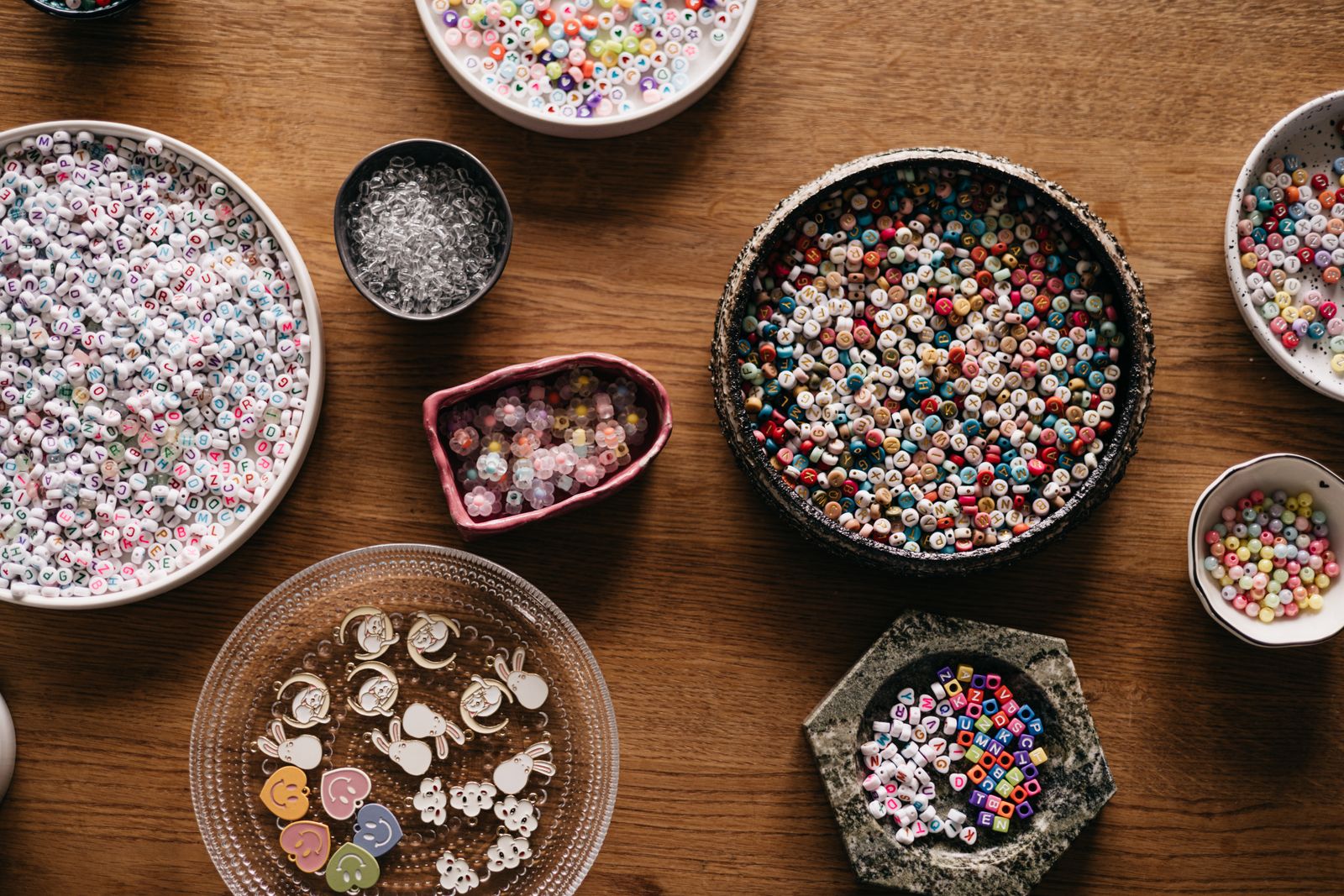
Letter beads are the most popular way to make a charm personal: a name, initials, a nickname, a short word or the year of something that matters to you. They are usually small acrylic cubes, rounds or flat discs with a letter on each, and they come in white with black letters, black with white letters, and in bright colours. See letter and name charms.
A few tips:
- Count your letters first. A pack may hold only a few of each letter. Write the word down and count, remembering repeated letters, such as the two Ns in Hannah or the two Ls in Ella.
- Space it out. Put a small bead or a seed bead between each letter. It makes the word easier to read, and stops the letters twisting against each other.
- Frame the word. Put the word in the middle of the strap or charm, with matching beads either side, so it reads as one piece.
- Check which way it reads. Hold the strap the way it will hang before you knot it. On a charm that hangs straight down, the letters read from top to bottom; on a strap, decide which side faces out.
- Keep it short. Initials or a short name read well. A long word makes a long, stiff charm.
Name charms make good presents, and two in matching colours, with each person's name or initial, make a pair for friends or a couple. See couples phone charms for ready-made pairs.
Adding pendants, rings and clasps
Metal fittings let you hang a pendant from beads, join several charms together, or make a charm you can take off and swap.
Jump rings
A jump ring is a small open ring of wire. To open one, hold it with a pair of pliers either side of the gap, then twist one hand towards you and the other away, so the ends move sideways past each other. Never pull the ends straight apart: that bends the ring out of shape and it never closes properly again. Hang the pendant or charm on it, then twist the ends back until they meet exactly, with no gap.
Split rings
A split ring is a tiny double coil, like a key ring. It is fiddlier to open, usually with a fingernail or a split-ring tool, but it cannot fall open on its own, so it is the better ring wherever the charm takes a pull.
Clasps
A small lobster clasp or spring clasp at the top of a charm lets you clip it on and off a strap or patch in seconds, and hang several charms from one point. Some clasps close with a magnet; those are best kept for charms that only hang, and away from small children, as the safety section below explains.
Crimp beads
If you string on beading wire, you finish it with a crimp bead, a small soft metal tube. Thread the crimp on, take the wire through the ring or clasp and back through the crimp, then squeeze the crimp flat with pliers. Use crimps sized for your wire, do not squeeze so hard the crimp cracks, and always tug the wire afterwards to check it holds.
Pendants
A pendant, such as a metal heart, a star or a small figure, usually has a loop at the top. Hang it from a jump ring threaded into the beads, or tie it into the middle of the strap as you string it. Heavier pendants pull the strap into a V, which can look good, but keep metal ones small if they will swing against the screen.
Making it strong enough to carry
A charm that only hangs carries almost nothing. A wrist strap is different: if you let go of the phone, the whole weight of the phone drops onto the strap, the knot and the ring. Make it with that in mind.
- Choose a cord that does not stretch. Nylon, polyester or beading wire for a strap that will carry the phone; elastic for charms that only hang.
- Use the cord double if the bead holes allow it. Two strands are much stronger than one, and the beads sit straighter.
- Tie it properly. A surgeon's knot, glued and left to dry fully, holds far better than a single knot.
- Use a split ring, not an open jump ring, wherever the strap meets the phone. An open ring can be pulled apart by a falling phone.
- Test it before you trust it. Hold the strap with the phone hanging just above a bed or a sofa, and give it a few firm tugs. If anything gives, it is better to find out there than over a pavement.
- Check it every few weeks. Cord wears fastest where it rubs on a ring or the edge of the lanyard patch. If you see fraying, a thinning strand or a ring that has opened, remake it.
The weakest point is often not the strap at all but where it fixes on. A lanyard patch is strong while the case holds it firmly, so a loose, stretched old case is worth replacing. A ready-made strap or patch can do the carrying while your handmade beads hang from it. See wrist straps.
Safety while you make
Beads, rings, crimps and clasps are all small parts. The NHS warns that young children put small objects in their mouths and can choke, and advises keeping such things out of their reach, so put the bead tray away when you stop, and pick up anything that drops. Magnetic clasps need extra care: the NHS warns that swallowed magnets can stick together inside a child's intestines. If you add a charm that lights up, its button battery must be kept well away from small children, because the NHS warns one that is swallowed can cause severe internal burns; if you think a child has swallowed one, OPSS says go straight to A&E or call 999. Older children can make charms happily, with someone keeping an eye on the small parts and the scissors.
Ideas to try
Once you have made one, the second is where the fun starts. Some ideas:
- A name strap in letter beads, framed by beads in a favourite colour.
- Pastel pearls and daisies, with a small clay flower in the middle, for a soft look on a clear case.
- A bright Y2K mix of colour beads, a smiley face, a butterfly and a star. See Y2K phone charms for the look.
- A matching pair for two friends, the same beads in swapped colours.
- A glow-in-the-dark charm to find the phone in a bag or on the bedside table at night. See glow-in-the-dark charms.
- A tassel charm, with a small tassel tied below a few beads. See tassel phone charms.
- Team or school colours, two or three colours in stripes.
- A seasonal charm: red and green beads for Christmas, orange and black for Halloween, pastels for spring, then back to your usual one.
- A charm to match a key ring, so phone and keys go together and are easier to find.
Handmade charms also make good presents, and a few made together, with a ready-made box, make a thoughtful one. See charm gift sets for sets to add to.
Questions people ask
How long should a wrist strap be?
Long enough to slip over your knuckles loosely, plus a little for the hitch onto the phone. Measure your own hand with a piece of string, or measure a strap you already like. Hands differ too much for one number to suit everyone.
Elastic or nylon cord?
Elastic is easier, and lets a strap slip over the hand, but it stretches over time. Nylon or polyester is better for a strap that carries the phone's weight. Use elastic for charms that only hang.
Can I use superglue on the knot?
A clear, flexible jewellery glue is better. Superglue can set brittle and wear the cord where it rubs. Whatever you use, let it dry fully before you trim the ends.
My phone has no hole. How do I fix the charm on?
Use a lanyard patch, which sits between the phone and the case with its loop out through the charging port opening, or a case with a lanyard hole. The complete guide to phone charms and straps explains each way.
Can children make phone charms?
Yes, older children enjoy it, with an adult keeping an eye on small parts. Keep beads, rings, magnets and button batteries well away from babies and toddlers.
How do I clean a handmade charm?
Wipe it with a soft cloth, slightly damp if needed, and let it dry. Do not soak it, which can loosen the knot and the glue. The guide to cleaning your phone safely has more.
Where to go next
Everything to start with is in DIY charm kits, the fittings are in charm rings and connectors, and ready-made charms of every kind sit alongside them for ideas. For the rest:
- Phone charms and straps: the complete guide: every kind, every theme and how they fix on
- Crossbody phone lanyards: if your strap is going to be a long one
- How to choose a phone case: including cases with lanyard holes